
7 Signs of Termites in Your Orange County Home
Wings, pellets, mud tubes and damaged wood are clues, not a diagnosis. Here is what each sign can mean, what it does not prove, and when to call a licensed inspector.
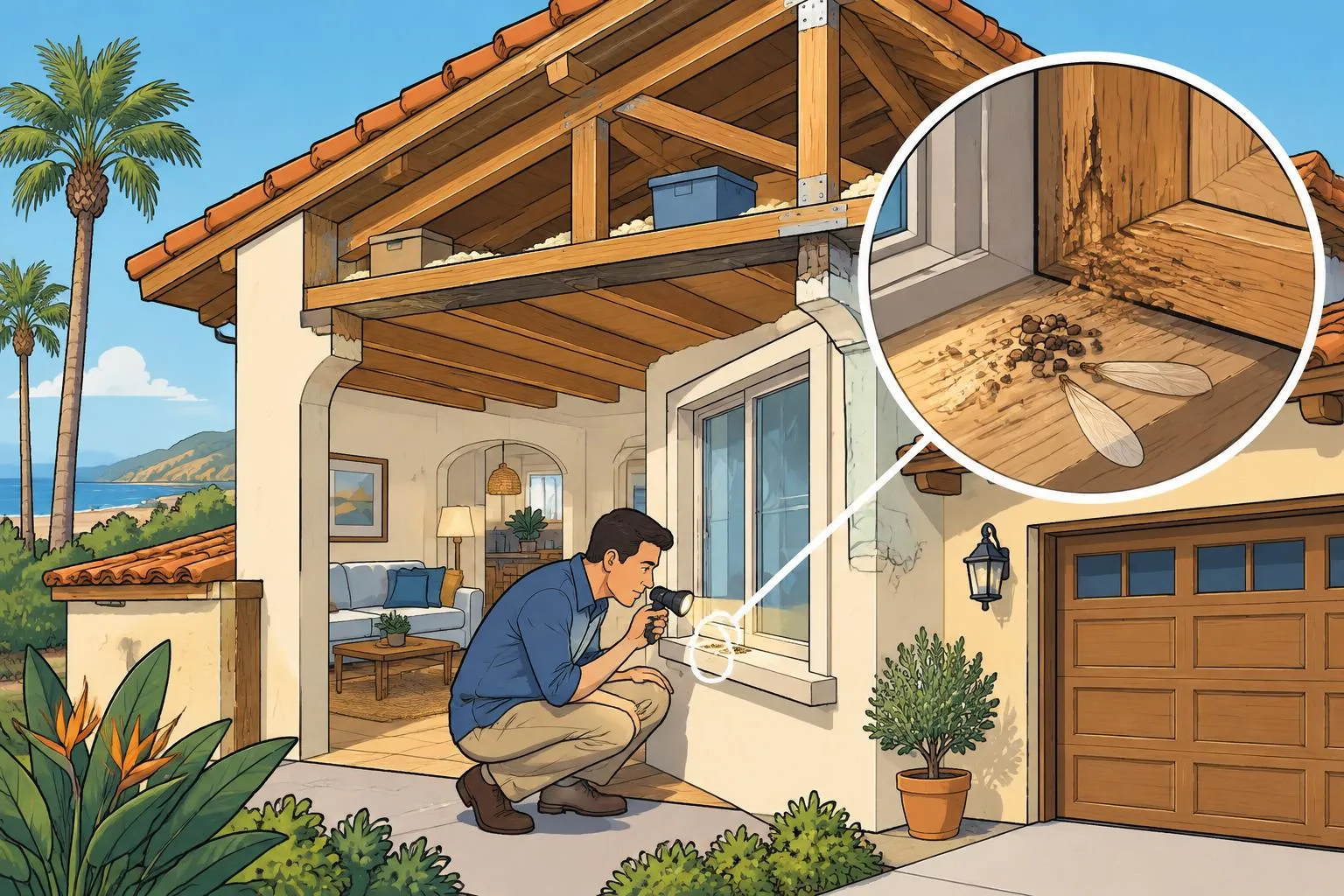
Most termite clues are small, easy to miss and easy to misread. No single sign tells you how much activity there is, or whether it is still active. Here are seven things worth noticing around an Orange County home, and what each one can and cannot tell you.
1. Discarded wings
Small piles of translucent wings near windows, doors or light fixtures often show up after termite swarmers have been active. Swarmers can fly in from outside, though, and some ants shed wings too. Wings are a reason to look closer, not proof that your home is infested.
2. Drywood termite pellets
Drywood termites push tiny, uniform pellets out of the wood they live in. Piles may collect on sills, baseboards or the floor below an infested board. Pellets alone do not prove activity is current; old pellets can stay in place for a long time.
3. Mud tubes
Subterranean termites live in the soil and build pencil-width mud tubes to reach wood. Look along foundation edges, slab joints, crawl space walls and garage stem walls.
4. Damaged or hollow wood
Wood that sounds hollow when tapped, blisters under paint or crumbles easily can point to termites. It can also point to moisture damage or decay, which is why identification matters.
5. Swarmers
Seeing winged insects emerge indoors or crawl around windows is one of the clearer clues. Drywood termites in Southern California commonly swarm on warm days in late summer and fall; subterranean termites often swarm after rain.
6. Surface changes that need a second look
Sagging trim, sticking doors, small holes or rippled paint have many causes. Treat them as something to mention to an inspector, not as a diagnosis.
7. Evidence you can't explain
If you keep finding something you can't identify, that alone is a good reason for a professional look. Inspecting and figuring out the extent of a drywood infestation requires experience, according to UC IPM.

Termites or flying ants?
Termite swarmers have straight antennae, a thick waist and four wings of similar length. Flying ants have elbowed antennae, a pinched waist and front wings longer than the back pair. If you can, save a few specimens in a sealed bag for the inspector.
A quick homeowner checklist
- Check window sills and light fixtures for wings
- Look under wood trim and furniture for small pellets
- Walk the foundation and garage for mud tubes
- Tap exposed wood such as eaves, fences and patio covers
- Keep firewood, lumber and mulch away from the house
When to call a professional
If you've found any of these signs, or you just want peace of mind, a licensed inspection can identify what you're seeing. Treasure Pest offers a FREE termite inspection for Orange County homeowners. Learn more on our termite inspection page or request your free inspection.
Your home deserves answers. Not guesses.
Request a FREE termite inspection. Our team will contact you to coordinate the next step.