Does Rain Wash Away Pest Control Treatments?
Sometimes it matters, sometimes it doesn't. Here's how treatment type, placement and label directions affect what rain does — and what to ask your technician.
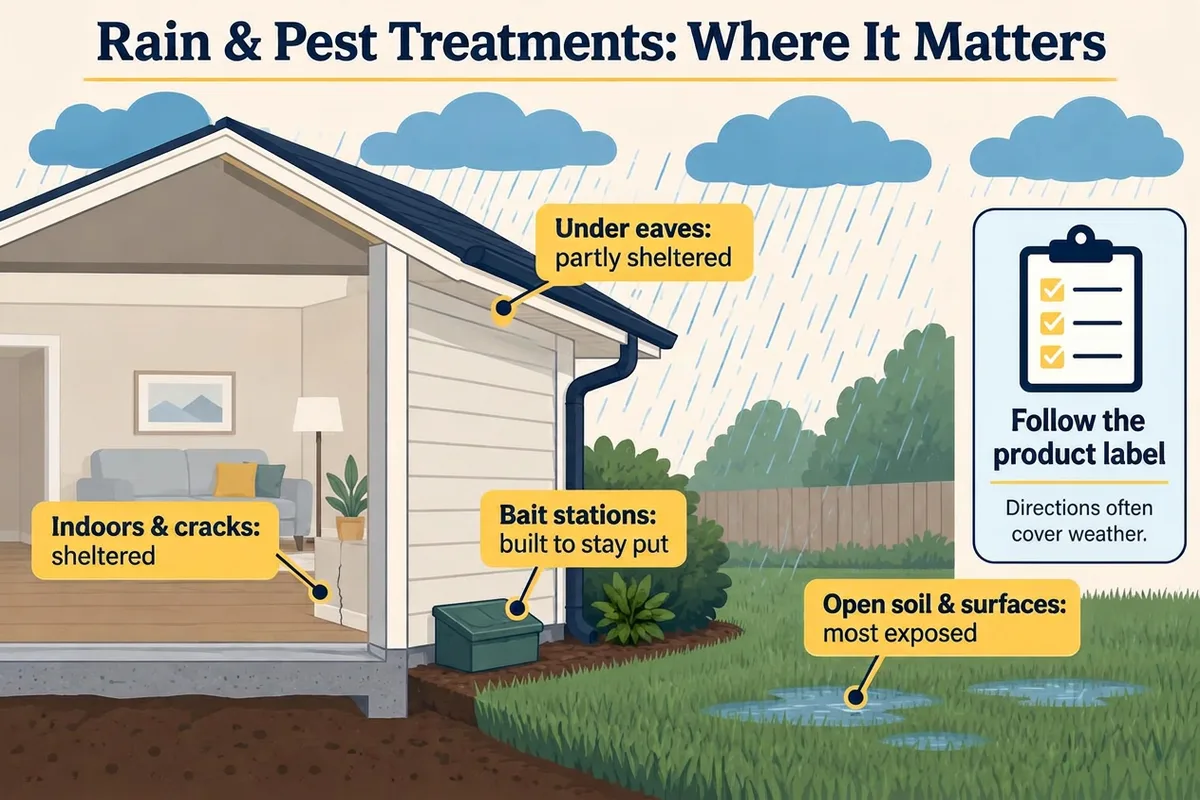
Short answer: It depends on the product, where it was applied and when the rain falls. Treatments placed indoors, in cracks, in bait stations or under eaves are usually sheltered. Exterior surface applications can be affected by heavy rain, especially soon after they're applied. Product labels often address weather, which is why a technician may adjust timing around a storm.
Why homeowners ask
You schedule a service, it rains that night, and you wonder if you just paid to water your yard. It's a fair question, and the honest answer is more useful than a yes or no.
It depends on the treatment
Where it goes
- Indoor and crack-and-crevice placements aren't exposed to rain.
- Bait stations and protected placements are designed to sit in place, though extreme flooding can still affect them.
- Under eaves and protected exterior areas get less direct rain.
- Open exterior surfaces and soil are the most exposed.
What it is
Different products bind to surfaces differently. Some need time to dry. Some are designed to hold up in outdoor conditions. That's why there's no single rule for every product.
Why the label matters
Every registered pesticide has a label with legally required directions. Many labels address weather, such as not applying before forecast rain or when soil is saturated. Following those directions is part of applying a product correctly, and it's one reason a technician might reschedule exterior work around a storm.
Rain before vs. after a service
- Rain before: Saturated soil and wet surfaces can affect whether exterior work should happen that day.
- Light rain after, once dry: Often less of a concern, depending on the product.
- Heavy rain soon after: More likely to affect exposed exterior applications.
Rain also changes pest behavior
Wet weather can push ants indoors and send rodents looking for dry shelter. So a burst of activity after rain isn't always a sign that a treatment failed. It can be pests reacting to the weather. See our El Niño prevention checklist.
What to ask your technician
- Which parts of today's service are protected from rain, and which aren't?
- Does the product label say anything about rain or wet conditions?
- Should we reschedule the exterior portion if a storm is coming?
- What should I watch for over the next couple of weeks?
- If activity continues, what's the next step under my plan?
When a follow-up visit may make sense
If you see continued or increasing activity after heavy rain, call and describe what you're seeing. Whether a follow-up is included depends on your service agreement, so ask about it upfront rather than assuming.
What you can do
- Keep gutters and downspouts working so water doesn't pool by the foundation.
- Turn down irrigation when rain is forecast.
- Clean up ant trails with soapy water rather than spraying store products over a professional treatment.
- Note dates and photos of new activity.
Questions about your own service? Call Treasure Pest or learn about our general pest control.
Sources: U.S. EPA: Pesticide Labels; UC IPM: Ants; California Department of Pesticide Regulation.
Worth remembering
Rain matters most for exposed exterior applications; ask what was treated where and what the label says about weather.
Rather have a local crew take a look?
Tell us what's going on and we'll help you figure out the next step.