
Argentine Ants in Orange County: Why They're So Persistent
Why Argentine ants keep coming back to South OC homes, how to recognize them, where they get in and what actually helps.

Short answer: The small brown ants trailing through most South OC kitchens are usually Argentine ants. Their colonies have many queens and spread across connected nests, so killing the ants you see barely dents the population. They come back because food, water and easy entry points are still there. Lasting results come from removing those and, when needed, a professional plan aimed at the colony.
How to recognize Argentine ants
- Small (about 1/8 inch), uniformly light to dark brown.
- Move in fast, steady, well-defined trails, often along edges.
- Trails often trace back outside to planters, mulch, or under pavers.
UC IPM calls the Argentine ant the most common ant in and around the house and garden in California. Its colonies link into one large "supercolony" with multiple queens.
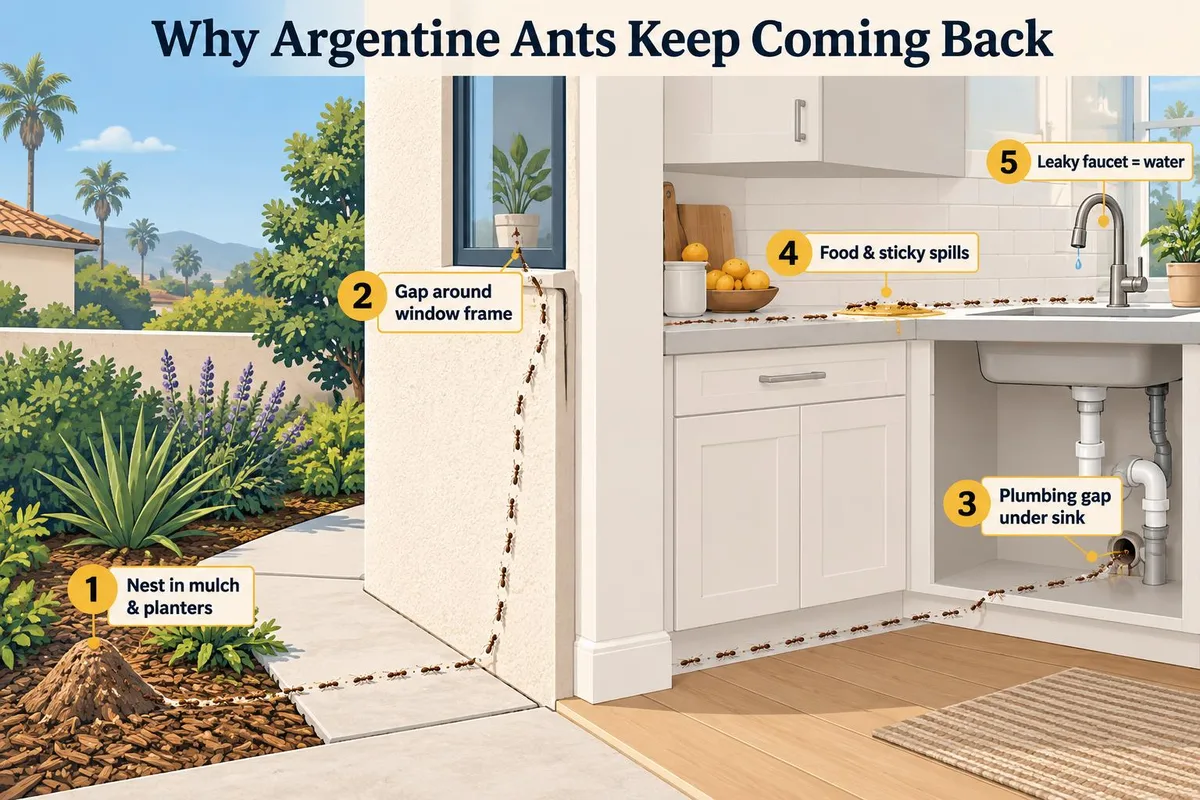
Why they're so persistent
1. Many queens. Losing some workers, or even some queens, doesn't end the colony.
2. Connected nests. Nests across your yard and your neighbors' can behave cooperatively.
3. Constant scouting. Foragers find new food quickly and recruit others with scent trails.
4. Weather shifts. Hot, dry spells send them looking for water; heavy rain floods nests and sends them looking for dry shelter. Both can bring them indoors.
5. Sweet food outdoors. They tend honeydew-producing insects such as aphids and scale on landscape plants.
Common entry pathways
- Gaps around windows and door frames.
- Baseboards and cracks in the slab.
- Plumbing and wiring penetrations under sinks and behind dishwashers.
- Plants and branches touching the house.
What actually helps at home
- Clean trails with soapy water. It removes the scent trail; UC IPM notes this is effective for trails you see.
- Find and remove the food. Sticky spots, pet food, crumbs and fruit bowls.
- Fix leaks and dry out problem areas under sinks and around tubs.
- Seal the obvious gaps you find while following the trail.
- Trim plants back from the walls and deal with aphids and scale on shrubs.
- Skip broadcast sprays indoors. Spraying scatters trails and rarely reaches the colony. UC IPM favors baits over sprays for ant colonies.
Seasonal patterns in South OC
Many homeowners notice invasions in late summer heat and again with the first rains. Our El Niño prevention checklist covers rain-season prep.
When professional assessment makes sense
If ants keep returning after a couple of weeks of cleanup, show up in several rooms, or appear in walls or electrical outlets, it's time for an assessment. A technician can trace trails back outside, look for the conditions driving them and recommend a targeted plan. See our ant control service and our guide to why ants keep coming back to the kitchen.
We serve communities including Mission Viejo, Rancho Mission Viejo and Laguna Niguel.
Sources: UC IPM: Ants.
Worth remembering
Argentine ant colonies are large and connected, so lasting results come from cutting off food, water and entry points, not just spraying the trail.
Rather have a local crew take a look?
Tell us what's going on and we'll help you figure out the next step.